
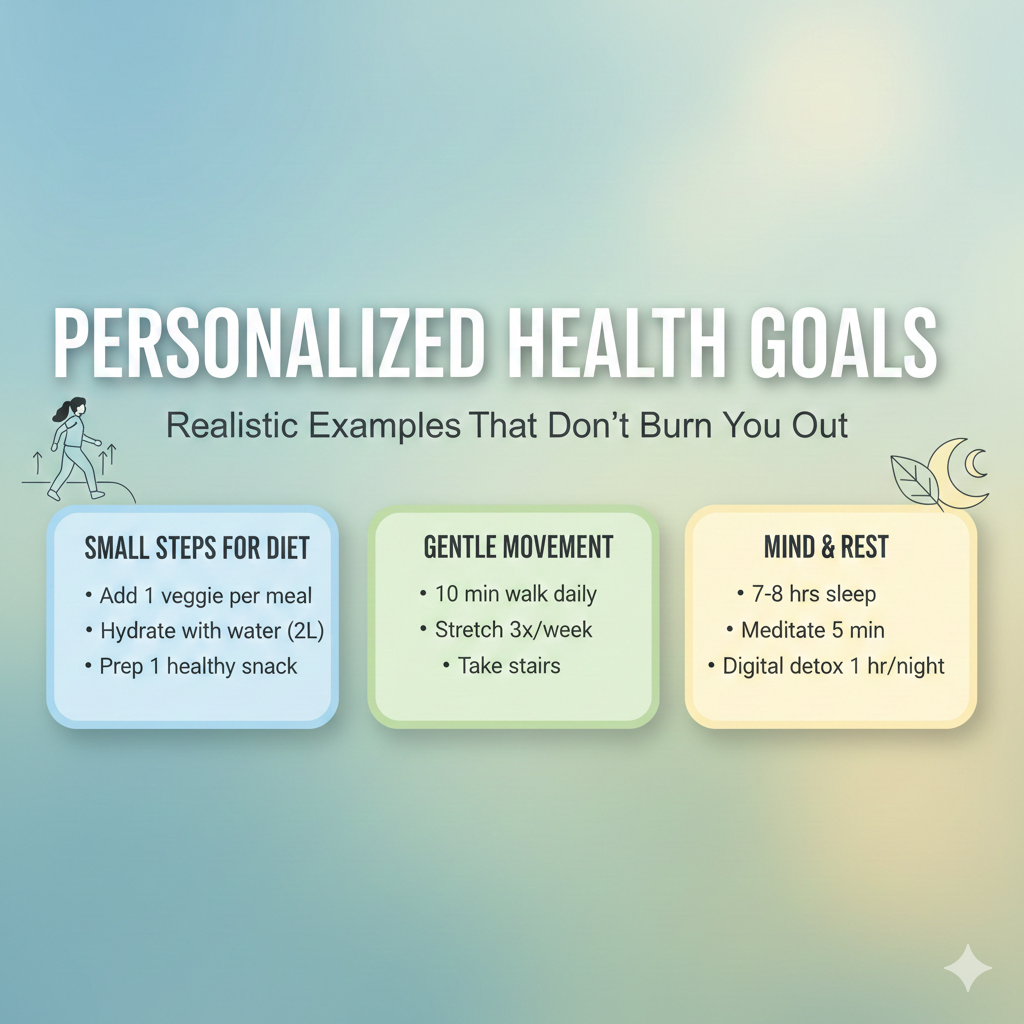
Introduction
Personalized health goals are realistic targets shaped around your lifestyle, energy, and limits—not ideal outcomes or social comparisons. When goals fit real conditions, consistency improves and burnout drops.
Many beginners set goals that look good on paper but collapse in practice. “Lose 10 kg in two months.” “Work out every day.” “Never miss a meal.” These goals fail not because people are lazy, but because they ignore context. This article shows how to design personalized health goals that match real lives, with practical examples for different situations—and a framework you can reuse without pressure.
Why Most Health Goals Fail (Even When Intentions Are Good)
Health goals fail for predictable reasons:
They focus on outcomes instead of behaviors
They assume constant motivation
They ignore time and energy limits
They rely on comparison rather than capacity
SERP Gap Insight:
Top SERP pages explain what goals to set, but rarely explain how to adapt goals when life interferes. That missing step causes most failures.
[Expert Warning]
If a goal requires perfect weeks to succeed, it’s not a realistic goal—it’s a stress trigger.
Outcome Goals vs Process Goals (The Key Shift)
Outcome Goals
Weight lost
Inches reduced
Numbers achieved
Process Goals
Actions repeated
Habits maintained
Systems stabilized
Information Gain:
Research-backed behavior change shows process goals outperform outcome goals for long-term adherence—yet most guides still emphasize outcomes.
The Personalized Goal-Setting Framework
Step 1: Define Your Current Capacity
Ask:
How many minutes can I realistically commit daily?
What drains my energy most right now?
What have I maintained before?
Step 2: Choose One Primary Health Domain
Sleep
Nutrition
Movement
Stress regulation
Step 3: Set a Minimum Viable Goal (MVG)
A goal you can complete even on bad days.
Personalized Health Goal Examples by Lifestyle
Example 1: Desk Job With Low Energy
Goal:
“Walk for 5 minutes after lunch on workdays.”
Why it works:
Anchored to routine
Low friction
Improves digestion + energy
Example 2: Busy Parent
Goal:
“Prepare one balanced meal per day.”
Why it works:
Reduces decision fatigue
Improves nutrition gradually
Example 3: Student With Irregular Schedule
Goal:
“Sleep within the same 60-minute window at least 5 days/week.”
Why it works:
Stabilizes energy
Supports focus
Example 4: Beginner Returning After Burnout
Goal:
“Stretch for 3 minutes before bed.”
Why it works:
Signals recovery
Builds confidence
[Pro-Tip]
If your goal feels too easy, you’re probably doing it right.
Beginner Mistake Most People Make
Mistake: Setting Goals Based on Motivation Highs
Motivation spikes are temporary. Goals built on them collapse when life normalizes.
Fix:
Set goals based on your average week—not your best one.
Common Mistakes
Mistake 1: Tracking Everything
Fix: Track one habit that matters most.
Mistake 2: Weekly Overcorrection
Fix: Adjust monthly, not daily.
Mistake 3: Comparing Results
Fix: Compare consistency, not speed.
Information Gain: Why “SMART Goals” Aren’t Enough
SMART goals (Specific, Measurable, Achievable, Relevant, Time-bound) are useful—but incomplete.
What SMART misses:
Energy variability
Stress cycles
Recovery needs
Upgrade:
SMART + Adaptive = goals that survive real life.
How Personalized Goals Fit Into a Wellness System
Personalized goals support:
A personalized wellness plan for beginners
A flexible wellness routine
Lifestyle-based wellness planning
Internal Links:
“beginner-friendly wellness planning” → Personalized Wellness Plan for Beginners
“designing flexible routines” → How to Create a Personalized Wellness Routine
Table: Realistic vs Unrealistic Health Goals
| Unrealistic Goal | Realistic Alternative |
| Exercise daily | Move 3× per week |
| Perfect diet | One balanced meal/day |
| Early wake-up | Consistent wake window |
| Rapid weight loss | Habit consistency |
FAQs
Q1. What are personalized health goals?
Goals tailored to your lifestyle, energy, and limits.
Q2. How many goals should beginners set?
One primary goal at a time.
Q3. Are small goals effective?
Yes. Small goals drive consistency and confidence.
Q4. Should goals change over time?
Yes. Review monthly or after life changes.
Q5. What if I miss my goal repeatedly?
Simplify it—misses are feedback.
Conclusion:
Personalized health goals work when they respect reality. When goals match your lifestyle and energy, progress feels natural instead of forced. Start small, adapt often, and let consistency—not intensity—define success.
Internal link:
Personalized Wellness Routines: How to Build Habits That Survive Stressful Days 2026
External link:
https://www.health.harvard.edu/category/common-conditions


