
Introduction
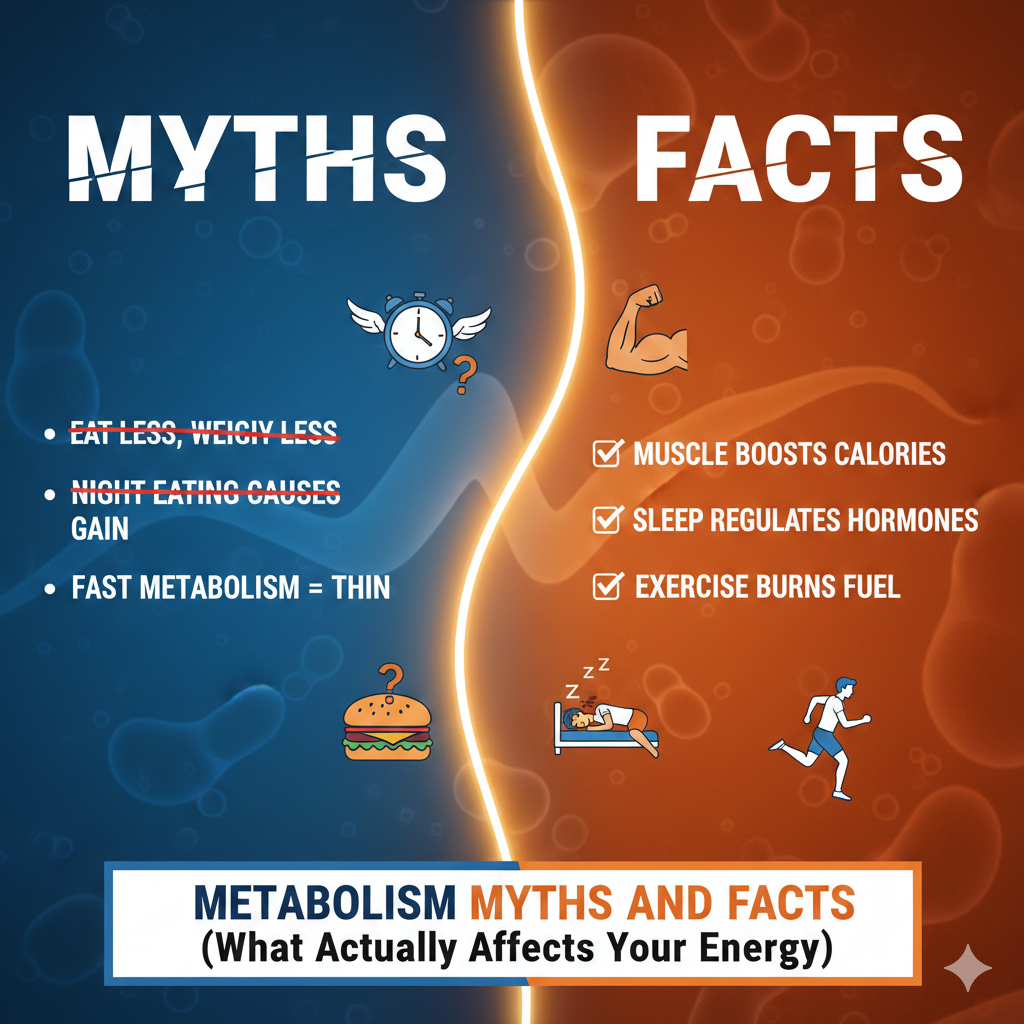
Many metabolism myths—like “some foods boost metabolism” or “eating less always helps”—mislead people and slow progress. The facts show metabolism responds to consistency, adequate fueling, sleep, stress, and muscle—not shortcuts.
Search results are full of promises about speeding up metabolism with teas, workouts, or special foods. When those don’t work, people assume their metabolism is broken. In reality, most frustration comes from believing myths that contradict how the body actually adapts. This article separates common metabolism myths from evidence-aligned facts, explains why these myths persist, and shows what truly influences metabolic health in everyday life.
Why Metabolism Myths Are So Convincing
Metabolism is invisible. You can’t feel it directly, so people rely on:
- Scale changes
- Energy levels
- Hunger signals
When those fluctuate, it’s easy to blame a “slow metabolism.”
SERP Gap Insight:
Top articles often repeat catchy claims without explaining why they’re misleading—leaving readers confused when results don’t match promises.
Some Foods Boost Your Metabolism
The Claim
Spicy foods, green tea, or vinegar dramatically increase metabolic rate.
The Fact
These foods may slightly raise energy expenditure for a short time—but the effect is tiny and temporary.
What Actually Matters More:
- Total energy intake
- Meal consistency
- Protein adequacy
[Expert Warning]
Relying on metabolism-boosting foods while under-eating often worsens metabolic health.
Eating Less Always Improves Metabolism
The Claim
The less you eat, the more fat you burn.
The Fact
Chronic calorie restriction tells your body to conserve energy.
Signs of this include:
- Fatigue
- Cold sensitivity
- Reduced recovery
Information Gain:
Many SERPs ignore that metabolism adapts downward in response to prolonged restriction—a key reason diets stall.
Cardio Is the Best Way to Speed Metabolism
The Claim
More cardio equals faster metabolism.
The Fact
Excessive cardio without enough fuel or recovery can:
- Increase fatigue
- Reduce muscle mass
- Lower resting energy use
Better Approach:
Combine moderate cardio with strength training and recovery.
If You’re Not Losing Weight, Your Metabolism Is Broken
The Claim
Weight plateaus mean metabolic failure.
The Fact
Plateaus often reflect:
- Energy balance adjustments
- Stress or sleep disruption
- Reduced non-exercise movement
Weight is a noisy signal—not a direct measure of metabolic health.
Metabolism Is Fixed by Age or Genetics
The Claim
Your metabolism is set in stone.
The Fact
While age and genetics influence metabolism, habits still matter greatly.
Metabolism responds to:
- Muscle mass
- Sleep quality
- Stress load
- Consistency of intake
From practical experience, people of all ages improve energy and metabolic flexibility when habits stabilize.
Beginner Mistake Most People Make
Mistake: Fixating on One Variable
People blame:
- Food
- Exercise
- Age
- Hormones
Reality:
Metabolism is multi-factorial. Fixing one piece while ignoring others rarely works.
[Pro-Tip]
If energy improves, metabolism is improving—even if the scale hasn’t moved yet.
Information Gain: Why Myths Persist Despite Evidence
Metabolism myths persist because they:
- Promise quick control
- Offer simple villains (carbs, calories)
- Ignore long-term adaptation
In contrast, the truth is less exciting:
Consistency beats intensity.
This perspective is often missing from top SERP results focused on clicks over clarity.
What Actually Improves Metabolism
Adequate, Regular Eating
Signals energy availability.
Strength Training
Maintains metabolically active tissue.
Quality Sleep
Regulates hunger and stress hormones.
Stress Management
Prevents energy conservation signals.
Long-Term Consistency
Allows adaptation in your favor.
Real-World Scenario: “I Tried Everything, Nothing Works”
Scenario:
Someone cycles through diets, workouts, and supplements.
What’s really happening:
- Repeated restriction
- High stress
- Poor recovery
Metabolism-supportive shift:
- Eat consistently
- Reduce extremes
- Focus on sleep and strength
From real-world experience, this shift often restores energy first—then progress follows.
How This Fits Into Metabolic Health
Understanding myths vs facts helps:
- Reduce frustration
- Prevent burnout
- Build sustainable habits
- Improve long-term outcomes
Internal Links (Contextual):
- “how to improve metabolism naturally” → How to Improve Metabolism Naturally
- “metabolic health vs weight loss” → Metabolic Health vs Weight Loss
Table: Metabolism Myths vs Reality
| Myth | Reality |
| Foods boost metabolism | Patterns matter more |
| Eating less is better | Under-fueling slows output |
| Cardio fixes metabolism | Muscle + recovery matter |
| Plateaus mean failure | Adaptation is normal |
| Metabolism is fixed | Habits influence it |
FAQs
Q1. Are metabolism boosters real?
Only minimally. Habits matter far more.
Q2. Can eating too little slow metabolism?
Yes. Chronic restriction triggers conservation.
Q3. Is cardio bad for metabolism?
Not inherently—but excess without recovery can be.
Q4. Can metabolism improve over time?
Yes, with consistent support.
Q5. Why do metabolism myths keep spreading?
They promise fast results and simple answers.
Conclusion:
Metabolism isn’t mysterious—it’s responsive. When you replace myths with steady habits, energy improves, frustration drops, and progress becomes sustainable. Skip shortcuts. Support the system.
Internal link:
How Metabolism Changes With Age (What Really Matters) 2026
External link:
https://www.health.harvard.edu/staying-healthy/foods-that-fight-inflammation


