
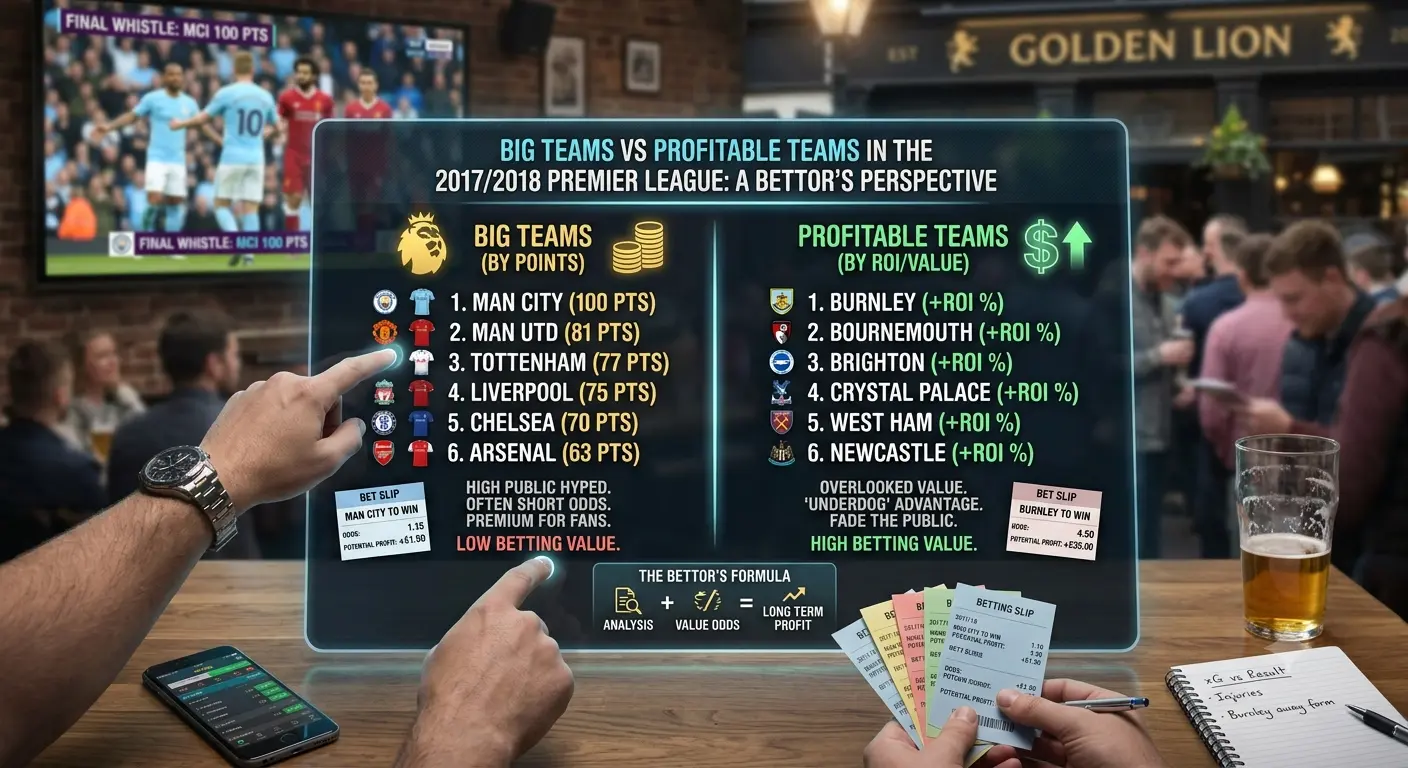
In the 2017/2018 Premier League, the most famous teams were not always the most profitable for bettors. The distinction between “big teams” and “money-making teams” reveals how perception, pricing, and performance interact to shape betting outcomes.
Why Popular Teams Often Underperform Against the Market
Big teams attract heavy betting interest, which influences how odds are set. Their popularity inflates expectations, often leading to shorter prices than their actual probability justifies.
The cause is demand-driven pricing. The outcome is reduced value on favorites. The impact is that even when big teams win frequently, they do not necessarily generate consistent profit over time.
What Defines a Profitable Team for Bettors
A profitable team is not defined by league position but by its ability to outperform market expectations. These teams are often undervalued relative to their actual performance.
Before applying this concept, it is important to understand the traits that characterized profitable teams:
- Consistent performance exceeding implied odds.
- Lower public attention reducing pricing distortion.
- Tactical stability leading to predictable outcomes.
- Strong defensive structure keeping matches controlled.
- Ability to exploit specific matchups repeatedly.
These characteristics create a gap between perception and reality. When teams consistently perform better than expected, they generate value regardless of their position in the table.
Interpreting profitability requires focusing on expectation versus outcome, not just results.
The Gap Between Results and Returns
Winning matches does not automatically translate into betting profit. Big teams often deliver results but fail to cover spreads or justify low odds.
Profitability vs Performance
The difference becomes clearer when comparing key aspects:
- Big teams win often but at low odds, limiting returns.
- Profitable teams may win less frequently but at higher value prices.
- Market expectations for big teams are consistently elevated.
- Smaller teams benefit from underestimated probability.
- Consistency against the spread matters more than total wins.
This comparison highlights that betting success depends on value, not reputation. The implication is that focusing solely on team strength leads to misleading conclusions about profitability.
How Market Perception Shapes Pricing
Odds reflect not only probability but also public opinion. Teams with strong branding or global followings tend to have prices adjusted accordingly.
A pattern emerges when analyzing how odds are presented across a betting platform. ufabet เข้าสู่ระบบ reflects this dynamic by incorporating market demand into pricing, meaning that popular teams are often slightly overvalued. The implication is that bettors who avoid following public sentiment can identify more efficient opportunities.
Identifying Undervalued Teams During the Season
Profitable teams often emerge gradually as the season progresses. Recognizing them early provides a significant advantage.
A structured identification process helps isolate these teams:
- Track teams consistently outperforming expected results.
- Compare actual outcomes with implied probabilities.
- Monitor market reaction to repeated overperformance.
- Evaluate tactical consistency rather than short-term form.
- Identify teams with stable lineups and clear roles.
This approach focuses on sustainability rather than isolated results. When patterns persist, the market often adjusts too slowly, creating continued value.
Applying this method improves long-term decision-making.
When Big Teams Become Profitable Again
There are periods when big teams regain value, particularly when market perception shifts negatively.
Common scenarios include:
- Short-term poor form leading to overcorrection in odds.
- Key players returning from injury.
- Tactical improvements under new management.
- Reduced public confidence creating longer prices.
- Matches against opponents with inflated reputation.
In these situations, the balance between perception and reality temporarily reverses. The impact is renewed value in teams that are typically overpriced.
Cross-Market Implications of Perception Bias
The distinction between popularity and profitability reflects a broader principle: visibility often distorts value.
A similar observation can be made in a casino online context, where widely favored options attract more attention despite not always offering optimal expected value. The implication is that understanding behavioral bias improves decision-making across different betting environments.
Balancing Data with Market Awareness
Successful betting requires combining statistical analysis with an understanding of market behavior. Data identifies performance, while market awareness reveals pricing inefficiencies.
Ignoring either side leads to incomplete conclusions. The most effective approach integrates both perspectives.
Summary
In the 2017/2018 Premier League, big teams and profitable teams were not always the same. Popular teams often suffered from inflated expectations, while less prominent teams delivered better value by exceeding market assumptions. Bettors who focused on pricing inefficiencies, rather than reputation, were better positioned to identify consistent profitability.
